Contents
- 1 Unraveling the Educational ‘Curriculum’: Who Determines Our History, Our Thoughts?
- 1.1 Educational ‘Curriculum’ Exposed !
- 1.1.1 Introduction—–
- 1.1.2 “The school curriculum is not neutral—it shapes ideology, politics, and culture. Who decides what children should learn and forget? Explore how education, history, and power are deeply connected, and why questioning the curriculum is essential for real freedom of thought.”
- 1.1.3 Pages missing from history are found—-
- 1.1.4 Who decides the curriculum? —–
- 1.1.5 Little children ‘sowing’ from ‘things’ —-
- 1.1.6 Invisible web of thoughts—-
- 1.1.7 The two faces of intellectuals—–
- 1.1.8 Economy and Curriculum——
- 1.1.9 Global agenda—–
- 1.1.10 The real role of education—-
- 1.1.11 About The Author
- 1.1 Educational ‘Curriculum’ Exposed !
Unraveling the Educational ‘Curriculum’: Who Determines Our History, Our Thoughts?
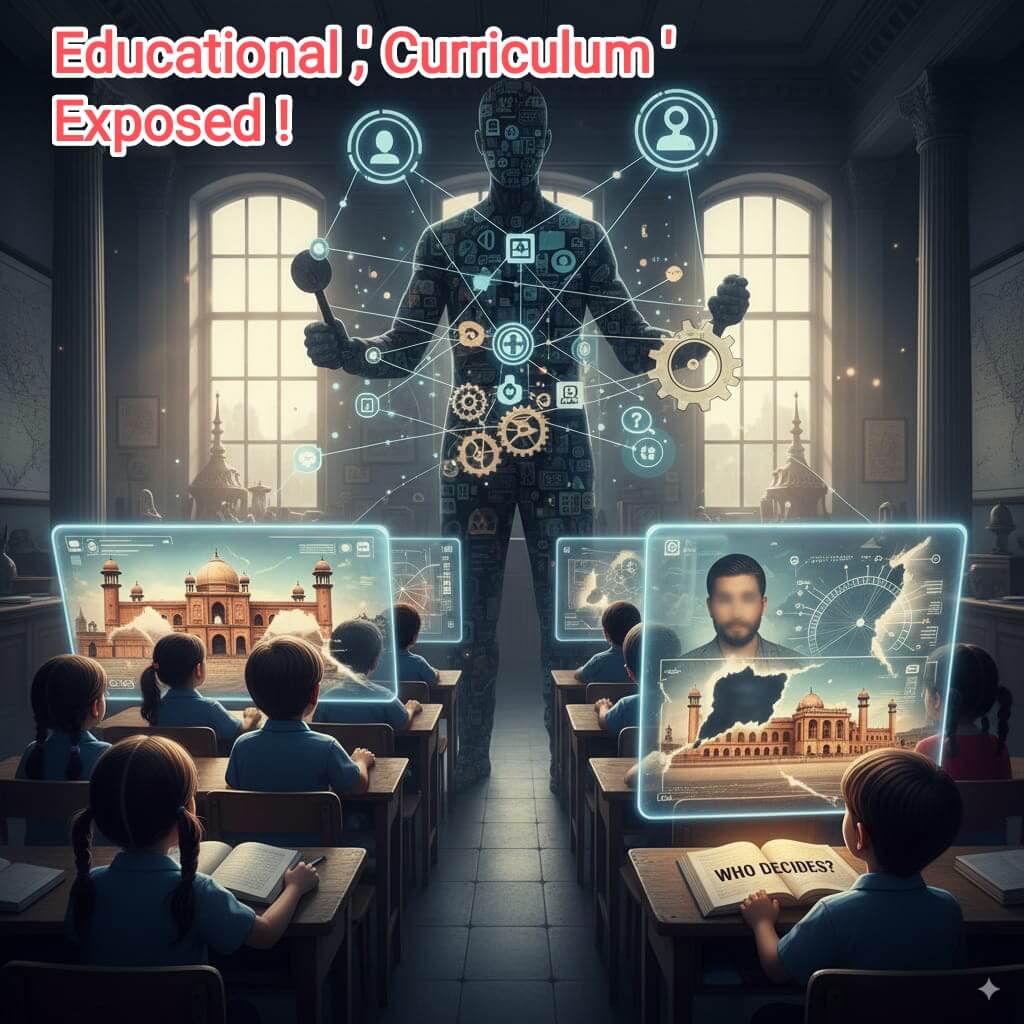
Educational ‘Curriculum’ Exposed !
Introduction—–
“The school curriculum is not neutral—it shapes ideology, politics, and culture. Who decides what children should learn and forget? Explore how education, history, and power are deeply connected, and why questioning the curriculum is essential for real freedom of thought.”
The curriculum in schools around the world is not as simple as it seems. It is not just lessons to be taught to children. The curriculum is a complete ideology. It is a lifelong sowing of the mind. It is determined by what the next generation should remember, what to forget, who to be proud of, and who to hate. And that is why this subject does not only remain within the academic limits but directly clashes with the core of politics, culture, and social order.
Pages missing from history are found—-
The same thing is happening even today. For example, we see that school history includes the Mughal era, attempts to destroy the tomb of Afzal Khan, the destruction of the Buddha statues in Bamiyan by the Taliban in Afghanistan, matching genealogies with desired ancestors, cutting out many references, etc. In some places, the ‘reformer’ face of the British is prominently shown. Then, hiding the financial loot, painting the desired image of Gandhiji, Ambedkar, etc. Why is this? Because the ruling people who write history decide what children should see and what they should forget!
The British wrote the history of India and taught it in this way for the policy of ‘divide and rule,’ and it seems that they strengthened their power by dividing it into sections like Brahmins, Dalits, Hindus, and Muslims. This is what has happened at the global level with Jews, Muslims, and Christians. The same experiment is going on under a different name, with a different agenda.
Who decides the curriculum? —–
The question here is that it is not important which subjects are taken in the curriculum; it is who decides it that is decisive. The government, the ruling party, and some ideologies have the right to decide the curriculum. Therefore, the curriculum becomes a political weapon.
Little children ‘sowing’ from ‘things’ —-
• Recall the stories we heard as children. Who do we feel proud of? Who do we hate? You will find this in them.
• Shivaji Maharaj is taught as a symbol of bravery, while the history of farmers’ rebellion is often suppressed.
• Women’s battles are shown as rare; the history of Dalits is omitted.
• Through all this, the values desired by the rulers are instilled in the minds of children. They live by them. But do we create our thoughts, or have others made them that way? This needs to be dismantled.
Invisible web of thoughts—-
• History, media, art, entertainment, and curriculum—an invisible web is woven around us through all these.
People are indirectly taught not to talk about ‘certain‘ topics and not to ask ‘certain’ questions. Gradually, this begins to seem natural to people as ‘common sense.‘
• People are also convinced that caste is natural. It is also said that these people have created it.
• We are forced to believe that gender inequality is ‘natural’ and ‘cultural.’
• We are taught to believe that profit in capitalism is natural. Behind it lies exploitation; this is hidden.
• But is all this really ‘natural’? Or is it an idea that someone has taught us? This fundamental question is never asked in the curriculum.
The two faces of intellectuals—–
• Intellectuals also play a big role in this game.
• Traditional intellectuals—These support the existing system. They accept power, religion, and culture as they are and convince people of it. They use their intelligence for power. They sell new inventions and technology in a way. The rulers of big and capitalist countries spend special money on these intellectuals and engage them in this work. Then they use it to maintain power. Such intellectuals are found in Israel, NASA, etc.
• Organic intellectuals—these come forward to change the system. They present new ideas from the perspective of workers, Dalits, women, scientists, and rationalists. For example, Dr. Nelson Mandela, Dr. Babasaheb Ambedkar, Karl Marx, George Washington, etc.
• Today, what is needed is for organic intellectuals to come forward. Because the knowledge gained from the curriculum often teaches us to accept it without asking questions.
Economy and Curriculum——
• The capitalist system also gives the curriculum a direction that it should remain ‘as is.’
• Children are taught ‘competition’ in school. But every person is unique. This is not taught. The ringing of the school bell only suggests the ‘bell’ of the work of future workers. It teaches them to use the same work and the same thought continuously until the bell rings.
• It is indirectly instilled without directly saying that “making profit” is the purpose of life.
• The worker is taught to work like a ‘machine‘ by doing the same work for hours.
• In today’s digital age, this has become even more dangerous. With new technologies like algorithms, the internet, and AI, man is being made a mere ‘consumer‘ instead of a thinking animal.
Global agenda—–
This game is not limited to India. The agenda of global capitalism is being played all over the world through curricula, media, films, and digital content. It seems to be leading to a ‘New World Order,’ in which they will be the rulers.
• Youth are turned into consumers by showering them with fashion, consumption, and entertainment. In it, examples and mentions of specific individuals, institutions, countries, leaders, ideas, and systems are glorified.
• People who ask questions in society are considered ‘rebels.’ They are considered traitors. Those who speak the truth are neutralized by mentions.
The real role of education—-
• What is education in essence?
• Teaching to ask questions.
• Teaching to find answers.
• Teaching to use one’s own thinking.
But current education stops at giving ready-made ideas. That is what happens in life.
Read more >>
1. Colonial Legacy & Curriculum
👉 The British Raj and Education in India – Wikipedia
2. Curriculum & Ideology
👉 Hidden Curriculum – Encyclopedia.com
3. Politics of Education
👉 Paulo Freire – Pedagogy of the Oppressed (Summary)
4. History Manipulation in Textbooks
👉 History Textbooks Controversies – The Hindu
5. Global Agenda & Education
👉 UNESCO – Global Education Monitoring Report
6. Organic Intellectuals (Antonio Gramsci)
👉 Gramsci and the Concept of Organic Intellectuals
7. Capitalism & Education
👉 The Role of Education in Capitalism – Monthly Review
Also read from same Writer>>
Exposer.blog – Exploring Truth, Depth, and Hidden Realities !
How does the global arms industry influence wars in the world?
About The Author

1 thought on “Unraveling the Educational ‘Curriculum’: Who Determines Our History, Our Thoughts?”