
Contents
- 1 Putin’s Interview with Indian Media: Deep Meaning for India–Russia Ties and the New World Order
- 1.1 What exactly was this interview?
- 1.2 Key messages to India: Respect, resilience and rupees
- 1.3 Messages to the world: NATO, Ukraine, Gaza and even God
- 1.4 The hard numbers: India–Russia ties in an infographic
- 1.5 The deeper layers: Why Putin chose Indian media
- 1.6 What does this mean for India’s foreign policy?
- 1.7 How Indian media quietly “won” this round
- 1.8 Free resources (for deeper reading):
- 1.9 Final takeaway
Putin’s Interview with Indian Media: Deep Meaning for India–Russia Ties and the New World Order
(Article by Dr. Nitin Pawar,India, 11 December 2025)
” In his first major interview with Indian media, Vladimir Putin praised India as a global power and defended Russia’s Ukraine stance. Here’s what it really means.”
When Vladimir Putin said this in his first full TV interview with Indian media in nearly two decades, speaking to India Today and Aaj Tak ahead of his 2025 state visit to New Delhi, he wasn’t just flattering his hosts. He was sending layered messages—to India’s public, to Western capitals, and to the wider Global South—all at once.
In this long read, we’ll unpack the deep meaning behind Putin’s interview with Indian media, using data, context, and some “infographic-style” stats to make sense of what’s really going on.
What exactly was this interview?
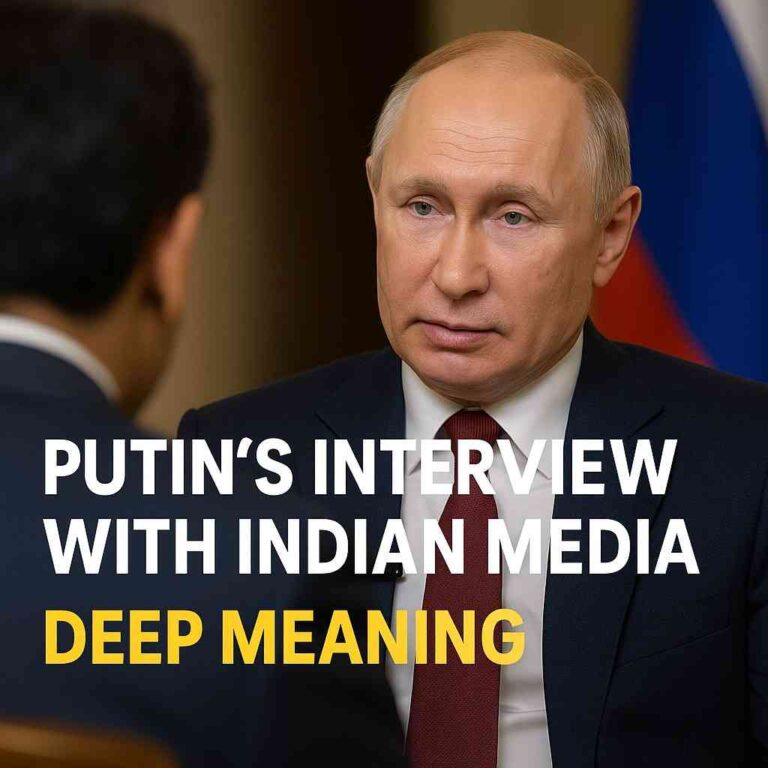
On 4 December 2025, just before landing in India for the 23rd Annual India–Russia Summit, Putin sat down inside Moscow’s historic Ekaterina Hall with anchors from India Today and Aaj Tak, part of the TV Today Network.
A few key points about the interview itself:
- Length: Around 100–110 minutes, far longer than the 60 minutes originally planned, making it Putin’s most extensive on-camera exchange with foreign journalists since his 2024 Tucker Carlson interview.
- Status: The Kremlin published a full transcript titled “Interview with Aaj Tak and India Today TV channels” on its official website, elevating a commercial TV interview to the level of an official presidential communication.
- Timing: Released barely a day before his New Delhi visit—meaning every line was calibrated for maximum diplomatic impact.
This was not a casual media appearance; it was a strategically scripted message to the world, delivered through an Indian lens.
Key messages to India: Respect, resilience and rupees
Let’s start with what Putin was saying directly to India and Indians.
“India is not a British colony”
Putin’s most replayed line was that India is a “major global player, not a British colony”, and that “everyone must accept this reality”.
Deeper meaning:
- He’s echoing India’s own narrative of strategic autonomy: India decides its Russia, US, or China policy—not Brussels or Washington.
- It’s also a polite but sharp message to the West: stop lecturing India on buying Russian oil, defence equipment, or maintaining friendly ties with Moscow.
Modi as “reliable” and immune to pressure
Putin also praised Prime Minister Narendra Modi as a leader who “does not succumb to pressure easily” and said India was “lucky” to have him.
Why this matters:
- Putin is personally investing in the Modi–Putin relationship, signalling continuity and trust.
- He’s telling Indian elites and business that Russia sees Modi as stable, dependable and strong—which reassures investors and bureaucrats who might be nervous about US sanctions.
India–Russia partnership “not directed against anyone”
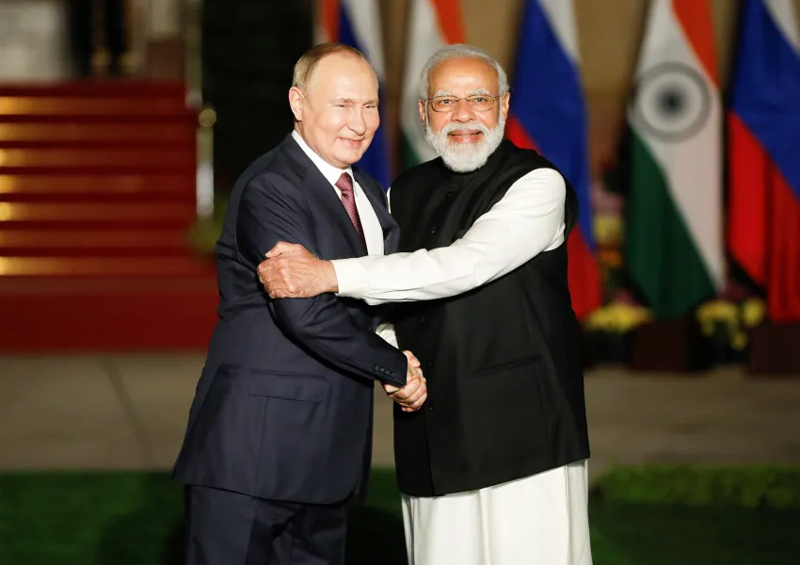
Putin stressed that Moscow’s collaboration with New Delhi is “not directed against any country”, only towards protecting each nation’s interests.
This fits perfectly with India’s long-standing diplomatic line:
- India wants good relations with Russia, but also with the US, Europe, Japan, and the Gulf.
- Putin is effectively saying: We’re okay with that. We don’t demand exclusivity.
Rupee–rouble, de-dollarisation and BRICS
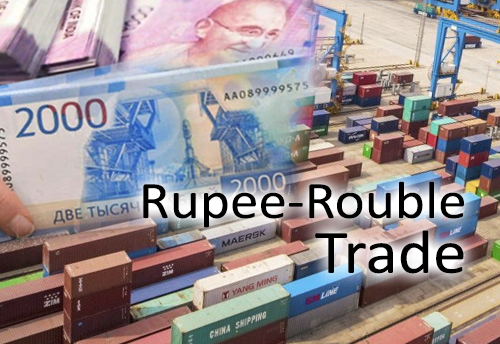
A big part of the interview focused on trade and payments:
- Putin said over 90% of India–Russia transactions are already conducted in national currencies (rupees and roubles or related arrangements).
- On a common BRICS currency, he argued there is “no need to rush”, preferring a gradual expansion of alternative payment mechanisms instead of a dramatic overnight shift.
The signal:
- To India: We are committed to keeping trade flowing even under sanctions. We’ll work around the dollar together.
- To the West: De-dollarisation is happening, but in slow motion, not as a sudden revolution.
India as a “full ally” against terrorism
Putin also called India a “full ally” in the fight against extremism and supported New Delhi’s tough stance on terrorism, including in its neighbourhood.
Deep meaning for India:
- Backs India’s position on cross-border terrorism without naming Pakistan outright.
- Positions Russia as a security partner not just in arms but in counter-terror narratives, in line with India’s own diplomatic messaging.
Messages to the world: NATO, Ukraine, Gaza and even God
Although the questions came from Indian journalists, much of the interview was actually aimed at global audiences.
NATO and Ukraine: Red lines restated
In the interview, Putin repeats familiar arguments:
- He calls NATO the real danger, not Russia.
- Insists Ukraine cannot join NATO at Russia’s cost and stresses that security for one country cannot come at the cost of another’s.
- He leans on a historical narrative in which Kyiv is described as the “mother of all Russian cities”, framing Ukraine as central to Russian identity.
This is less about persuading India (which has already chosen neutrality) and more about:
- Restating Russia’s justification to Global South viewers.
- Showing that India is willing to give him a platform—even as Western networks remain adversarial.
Gaza, Palestine and the Global South angle
Putin also comments on the Gaza conflict, supporting the idea that an independent Palestinian state is essential for lasting peace.
Why say that on Indian TV?
- India has strong ties with both Israel and Palestine, and Indian public opinion is sensitive to civilian deaths.
- By engaging this topic, Putin positions himself as a Global South statesman who speaks not only about Russia’s interests but also about wider Middle Eastern and humanitarian issues.
Trump’s peace efforts and great-power theatre
The interview also touches on former US President Donald Trump’s attempts to broker a peace deal in Ukraine, with Putin commenting on diplomacy efforts and sanctions.
- Putin uses this to show he is open to dialogue, even with adversaries.
- For Indian viewers, it reinforces the idea that Russia is not isolated, but in constant negotiation with other big powers.
“Everything ends, only God is eternal”
One of the more philosophical moments came when Putin was quizzed about his viral hot-mic conversation with China’s Xi Jinping on longevity and life extension.
He replied that “everything ends, only God is eternal”, while still saying human life expectancy can be extended with advances in medicine and AI-driven drug discovery.
This does three things:
- Projects an image of Putin as philosophical and fatalistic, not just a cold strategist.
- Signals comfort with religious language to conservative audiences worldwide.
- Wraps his interest in science and AI in a “humble” framework: technology can advance, but we’re not gods.
The hard numbers: India–Russia ties in an infographic
To understand the deep meaning of the interview, we have to look at data, not just quotes.
Trade, arms, oil and diplomacy at a glance
Infographic-style snapshot: India–Russia Relationship in Numbers
| Dimension | Key Data | Why It Matters |
|---|---|---|
| Bilateral Trade | India–Russia trade hit USD 68.7 billion in FY 2024–25, about 5.8× higher than the pre-pandemic level of USD 10.1 billion. | Trade has boomed, mainly thanks to discounted Russian oil. |
| Trade Imbalance | India exports ~USD 4.9 bn to Russia and imports ~USD 63.8 bn—13:1 imbalance heavily in Russia’s favour. | India is worried about sustainability; wants to boost exports. |
| 2030 Trade Target | Both sides have set a goal of USD 100 bn trade by 2030. | The interview helps “sell” this ambition domestically. |
| Oil Imports | Russian crude jumped from negligible levels pre-2022 to about 35–36% of India’s oil imports, roughly 1.6–1.8 million barrels per day in 2023–25. | India saved over USD 10 bn in two years thanks to discounts. |
| Arms Imports | Russia still supplies 36% of India’s major arms imports in 2020–24, but that’s down from 72% in 2010–14 and 55% in 2015–19. | India is diversifying to France, the US and Israel, reducing dependence on Moscow. |
| UN Votes on Ukraine | In major UN resolutions on Ukraine, 141 countries voted to condemn Russia, while India joined a group that abstained (about 32 abstentions). | India has walked a careful neutrality line, not endorsing Russia but not opposing it. |
| Currency Use | Over 90% of India–Russia transactions now reportedly use national currencies rather than the US dollar. | This supports gradual de-dollarisation and reduces sanctions risk for both. |
If you imagine this as a visual infographic, the takeaway is clear:
- Energy + discounts are the new backbone.
- Arms dependence is declining, but still significant.
- Trade is big but one-sided, and India wants to fix that.
- Diplomatically, India is trying to have it both ways: friendliness with Moscow, engagement with the West.
Putin’s interview is scripted directly against this backdrop.
The deeper layers: Why Putin chose Indian media
Now, let’s dig into the deep meaning—the strategic layers behind this interview.
Shifting the media centre of gravity
For nearly two decades, Putin avoided long interviews with foreign TV networks, especially Western ones. But in December 2025 he chose:
- An Indian network (India Today/Aaj Tak),
- Broadcast across a massive Hindi and English-speaking audience,
- And then had the Kremlin archive the interview as an official presidential document.
This signals:
- The information war is tilting towards the Global South.
Western media no longer monopolise “the global narrative”. - Russia is betting that Indian media gives it both reach and credibility among non-Western audiences.
- The Kremlin wants India to be seen not just as a strategic partner but as an information hub.
Flattery as strategy: Talking to India’s self-image
Lines like “India is lucky to have Modi” or “India is not a colony” aren’t just emotional—they’re strategic.
They directly plug into:
- India’s sense of having “arrived” as a major power,
- The narrative of throwing off colonial and neo-colonial pressures,
- Domestic pride in “Vishwaguru” (world-teacher)–style messaging.
This helps Russia:
- Build public goodwill in India,
- Make it harder for any Indian government—current or future—to dramatically downgrade ties with Moscow under Western pressure.
Economic messaging: Oil, fertilisers, and RT India
During the visit linked to this interview, Russia and India:
- Reiterated plans to keep uninterrupted fuel supplies to India, despite US sanctions.
- Advanced deals on fertilisers (including a joint venture with Russian group Uralchem) and agriculture, with bilateral agri-trade around USD 3.5 billion.
- Pushed towards the USD 100 bn trade target, discussing rupee–rouble mechanisms and easing non-tariff barriers.
At the same time, Putin formally launched RT India, a major overseas expansion of Russian state-backed media with a large team and studio presence in Delhi.
So the interview is part of a three-layered push:
- Energy & trade – “We’ll keep your oil cheap and your fertiliser flowing.”
- Finance – “We’ll find ways around the dollar.”
- Media & narrative – “We’re here in your information space now—RT India has entered the chat.”
Respecting India’s multi-alignment
Interestingly, Putin also said Russia sees both India and China as “closest friends”, and promised Moscow wouldn’t interfere in India–China relations.
That’s a subtle but important line:
- Moscow acknowledges that India has its own issues with China, but doesn’t want to be forced to choose sides.
- It reassures Delhi that Russia’s growing partnership with Beijing doesn’t automatically make India a junior partner or adversary.
In other words, Putin is validating India’s multi-alignment doctrine—the idea that India can work with Russia, the US, Europe and others simultaneously, based on issue-by-issue interests.
Putin’s personal brand: Philosopher-warrior
Finally, the interview also serves to recraft Putin’s personal image:
- Long, detailed historical explanations on Ukraine.
- Philosophical lines about mortality and God.
- Warm, almost sentimental language about Modi, Indian culture, and ordinary Indians.
He appears as:
- Unapologetic on security issues,
- Soft-spoken and respectful towards India,
- Curious about technology and longevity,
- And positioned as a survivor-statesman, not a cornered authoritarian.
For Indian audiences, that mix is designed to say:
You may disagree with him, but you can’t ignore him.
What does this mean for India’s foreign policy?
From India’s side, the interview and visit highlight a delicate balancing act.
The opportunities
- Energy security at a discount
- Russian oil has helped cut India’s import bill by over USD 10 billion in two years, while still allowing India to re-export refined products.
- Defence co-production instead of simple imports
- Russia remains India’s single largest arms supplier (36% share), but both sides are exploring joint production and local manufacturing to fit India’s “Atmanirbhar” (self-reliant) defence push.
- Agriculture, fertiliser and food security
- Deals with Uralchem and growing agri-trade (approx. USD 3.5 bn) give India a more secure fertiliser and grain pipeline.
- Technology, space and nuclear cooperation
- Existing collaboration in nuclear energy (e.g., Kudankulam) and space gives India access to large projects and technology at lower political cost than some Western options.
The risks
- Overdependence on a sanctioned economy
- Too much reliance on Russia for oil and arms ties India’s fortunes to a country under heavy Western sanctions, raising financial and reputational risks.
- Trade imbalance and structural weakness
- The 13:1 trade imbalance means India is essentially funding Russia’s war economy while struggling to find a strong export base into Russia.
- Western technology and defence access
- Washington, Paris and others watch India’s Russia ties carefully. Too much closeness could slow access to high-end Western tech or complicate Indo-Pacific cooperation.
- Global image and moral positioning
- India’s repeated abstentions at the UN on Ukraine have attracted criticism from some Western commentators, who accuse it of fence-sitting.
Putin’s interview is thus a helpful shield: it frames India’s position as principled and respected by Moscow, even as New Delhi continues its quiet diversification away from Russian arms and towards Western partners.
How Indian media quietly “won” this round
There’s also a media power story here.
- India Today and Aaj Tak became the global reference point for Putin’s 2025 messaging, with international outlets citing clips and lines from their interview.
- The Kremlin’s decision to host the transcript on its official website gave the Indian channels a kind of diplomatic accreditation—they were no longer just TV networks, but part of the formal record of Russian state communications.
- The interview lasted far longer than expected, with Putin taking questions on everything from Gaza to Trump to longevity, reinforcing the idea that Indian media can host serious, globally relevant conversations.
For Indian soft power, that’s huge: it moves Indian news from the category of “regional media” into the club of platforms where great-power leaders choose to speak to the world.
Free resources (for deeper reading):
1. Full Kremlin transcript:
   "Interview with Aaj Tak and India Today TV channels" – Kremlin official website
   https://en.kremlin.ru/events/president/news/78649

2. India Today world exclusive video:
   "Watch Vladimir Putin's full interview with India Today – a world exclusive"
   https://www.indiatoday.in/india/video/watch-vladimir-putins-full-interview-with-india-today-a-world-exclusive-2830972-2025-12-04

3. India Today analysis piece:
   "How Putin's India Today interview shattered Western media's global monopoly"
   https://www.indiatoday.in/world/story/how-putins-india-today-interview-shattered-western-medias-global-monopoly-2831610-2025-12-05

4. MEA / Indian government briefing:
   "From Strategic Partnership to Special and Privileged Bond" – Government of India press note
   https://www.pib.gov.in/PressReleasePage.aspx?PRID=2198621

5. Official trade overview:
   "Brief on India–Russia Economic Relations" – Embassy of India, Moscow
   https://indianembassy-moscow.gov.in/overview.php

6. Arms transfer data:
   "Trends in International Arms Transfers, 2024" – SIPRI
   https://www.sipri.org/yearbook/2024/06

7. Oil and sanctions context:
   "How India plans to continue buying Russian oil despite sanctions" – Al Jazeera
   https://www.aljazeera.com/news/2025/12/9/how-india-plans-to-continue-buying-russian-oil-despite-sanctions

8. RT India background:
   "RT India" – Wikipedia
   https://en.wikipedia.org/wiki/RT_India
Final takeaway
Putin’s interview with Indian media was not just about charming an Indian audience. It was:
- A carefully staged global broadcast from a Global South platform,
- A reassurance to India that Russia respects its independent, multi-aligned foreign policy,
- A defence of Moscow’s positions on Ukraine, NATO, oil and sanctions,
- And a subtle pushback against Western narrative dominance.
The deep meaning is this:
In 2025, if you want to speak to the world beyond the West, talking through Indian media may now be as powerful as talking to CNN or BBC once was.
And that, perhaps, is the biggest story hiding inside this long, meticulously choreographed conversation in Ekaterina Hall.
Read more >>>>>
China–Japan Conflict 2025: An Analysis
P M Modi Assassination Attempt Conspiracy: The Untold Story Behind the Intelligence Operation
About The Author