
Contents
- 1 How does the global arms industry influence wars in the world?
- 1.0.1 “Explore how the global arms industry shapes modern wars. From $2.4 trillion military spending to the rise of drones, AI, and private defense companies, this article analyzes economic growth, environmental impact, and human costs of the arms trade, with insights into conflicts like Ukraine and Gaza.”
- 1.0.2 Introduction—
- 1.0.3 Military Industrial Complex (MIL-IND)—
- 1.0.4 The economic size of the ‘global arms ——-
- 1.0.5 Growth of new industries—-
- 1.0.6 Expansion of the arms industry—–
- 1.0.7 Impact on the environment and human life—-
- 1.0.8 War, arms commercialization, and policy implications—
- 1.0.9 Self-reliance and export policy—
- 1.0.10 Historical context—
- 1.0.11 Conclusion—
- 1.0.12 About The Author
How does the global arms industry influence wars in the world?
“Explore how the global arms industry shapes modern wars. From $2.4 trillion military spending to the rise of drones, AI, and private defense companies, this article analyzes economic growth, environmental impact, and human costs of the arms trade, with insights into conflicts like Ukraine and Gaza.”
Introduction—
What is the relationship between the international arms manufacturing industry and the current and past wars around the world? Let’s try to understand this in this article!
Military Industrial Complex (MIL-IND)—
It is a fundamental basis of modern warfare and the global security system. It is important for us to analyze the role of weapons in these wars and the economic, environmental, and human casualties they cause.
The economic size of the ‘global arms ——-
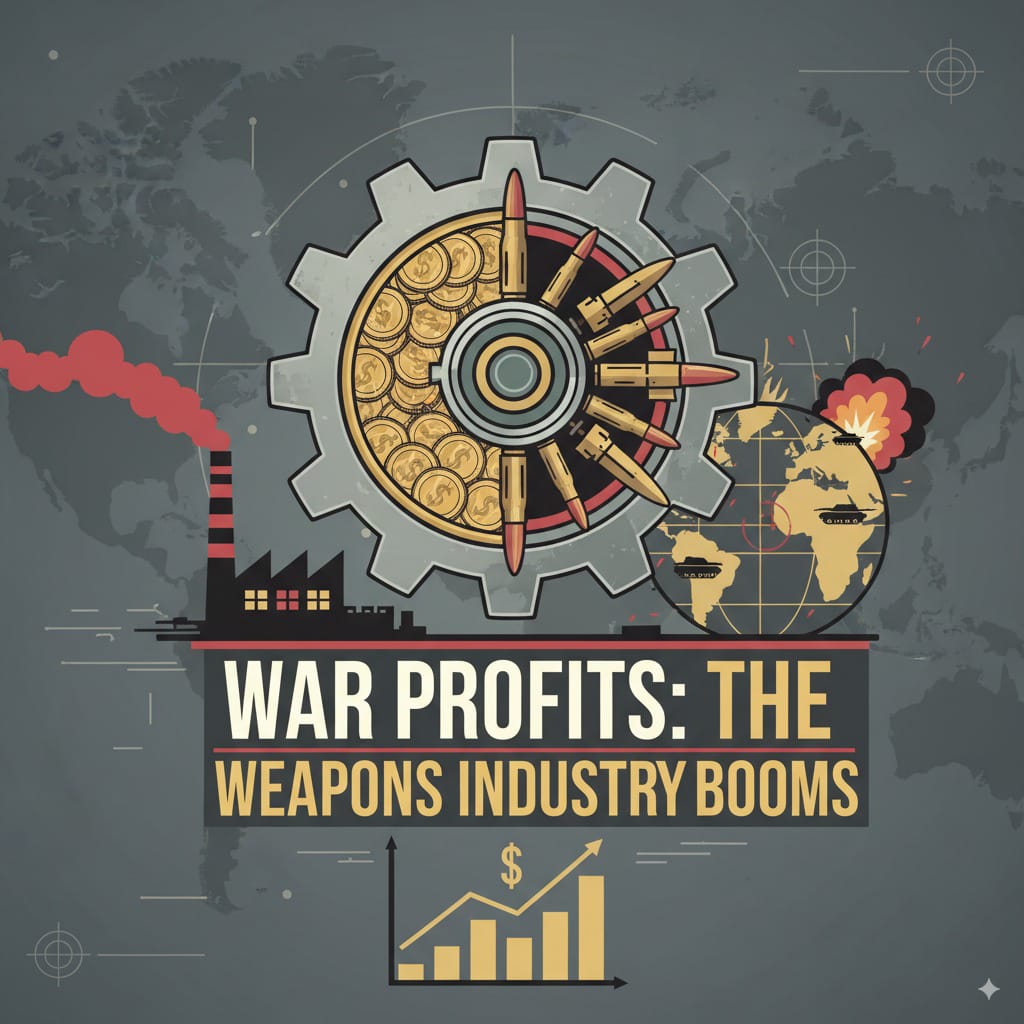
The total market value is as follows.In 2022, the value of the global arms industry was about $361 billion. The United States had a share of about 39%.In 2023, this value increased to $475 billion.In 2023, the five leading arms exporting countries were the United States, Russia, France, China, and Germany.
A statistic on military spending is as follows:In 2022, the total global military expenditure was $2.240 trillion. Of this, the US share was 39% (~837 billion).According to SIPRI, global spending on wars increased in 2024. It reached $2.443 trillion. This is the highest war spending ever recorded.
The revenue of large companies in the arms industry is reported as follows.In 2023, the combined revenue of the world’s 100 largest arms manufacturers was $632 billion.
Increased arms demand and income due to wars (2022–2024) are reported as follows.The Ukraine war has boosted US arms exports since 2022. Between 2020 and 2024, US arms exports increased by 20%. The US’s global share reached 43%. This is more than four times that of France.
Ukraine has In 2024, arms imports were 100 times higher than in the previous period.Also, arms imports to European countries increased by 155%.In 2023, arms industry revenue increased by 4.2%. It reached $632 billion.
Of this, American companies earned $317 billion (an increase of 2.5%).Russian companies were not left behind. Rostec is a Russian company. Its revenue increased by 40%. Also, the revenue of companies in the Middle East increased by 18% to $19.6 billion.
The revenue of Israeli companies reached a high due to the Gaza conflict. It is $13.6 billion, the highest in SIPRI history.
Technology, innovation, and war Drones and AI-based technology have started to fight wars. This has become less costly and more effective. Especially in Ukraine, the widespread use of drones has been crucial for its defense.
Growth of new industries—-
Russia has brought in traditional giant manufacturers through startups like Anduril and Palantir. Their products use software-driven warfare and autonomous systems.
Expansion of the arms industry—–
The role of private companies in information technology, logistics, and satellite communication systems has increased. For example, Starlink has overcome internet restrictions in warfare.
Impact on the environment and human life—-
Environmental impact:
The impact of military activities on the carbon footprint is estimated at 5.5% of global emissions. But the actual level is indicated to be higher.The first two years of the Ukraine war produced more carbon emissions than the annual emissions of the Netherlands. This is a very serious global impact.The pollution caused by the United States military, especially CFC emissions, is more than that of any other five chemical companies.
Human suffering and displacement:
Example—The intervention in Yemen/Saudi/UAE has killed an estimated 400,000 people. Millions have been displaced. The arms industry played a major role in this.In Syria, about 500,000 people died, and millions were displaced. Arms suppliers prolonged the conflict.
According to one study, more than 200,000 people died in 2013–2017 due to weapons supplied by G20 countries. Examples—Yemen, Syria, and elsewhere.
War, arms commercialization, and policy implications—
International Arms Trade Treaty (ATT):
It came into force in 2014. It was ratified by 116 countries. Its aim is to promote transparency, reduce violence, and take responsibility.
Self-reliance and export policy—
India emphasized local production in 2022–2023 under “Make in India.” Three major Indian companies together achieved $6.7 billion in revenue. (5.8% growth).
According to Reddit, 2019–2023 Meanwhile, India’s dependence on Russia has decreased (from 76% to 36%), and in 2024, India exported arms worth $2.63 billion.
Historical context—
Expectations of wartime production in World War II.The Allies achieved a significant numerical increase in the production of guns, aircraft, ships, and tanks compared to the Axis in 1939–1945. (e.g., the Allies produced ~4.36 million tanks; the Axis produced ~0.67 million).
Today’s technology-based models and the use of small but skilled forces are completely different in this historical context. This is important to understand. But production capacity and war industries remain important.
Conclusion—
The arms industry has a profound economic, technological, environmental, and human impact on wars around the world.In economic terms, the industry has reached a total of $475–632 billion. Military spending has reached $2–2.4 trillion.The outbreak of wars, especially the conflicts in Ukraine and Gaza, has increased both demand and revenue.Technologically, AI, drones, satellite communications, and the rise of the private defense sector point to a new era.This is true with very serious impacts on environmental and human values. For example, the arms industry directly affects carbon emissions, displacement, and deaths.A self-sufficient local economy for the future, along with the widespread use of technology, requires more regulation.
Read more >>
1. SIPRI – Stockholm International Peace Research Institute
2. Statista – Global Arms Industry Market Size
3. Our World in Data – Military Spending
4. United Nations – Arms Trade Treaty
5. World Bank – Military Expenditure Data
6. Amnesty International – Arms Control & Human Rights
7. Council on Foreign Relations – Global Arms Trade
Read more by ‘Exposer’—
Exposer.blog – Exploring Truth, Depth, and Hidden Realities !
About The Author



2 thoughts on “How does the global arms industry influence wars in the world?”