
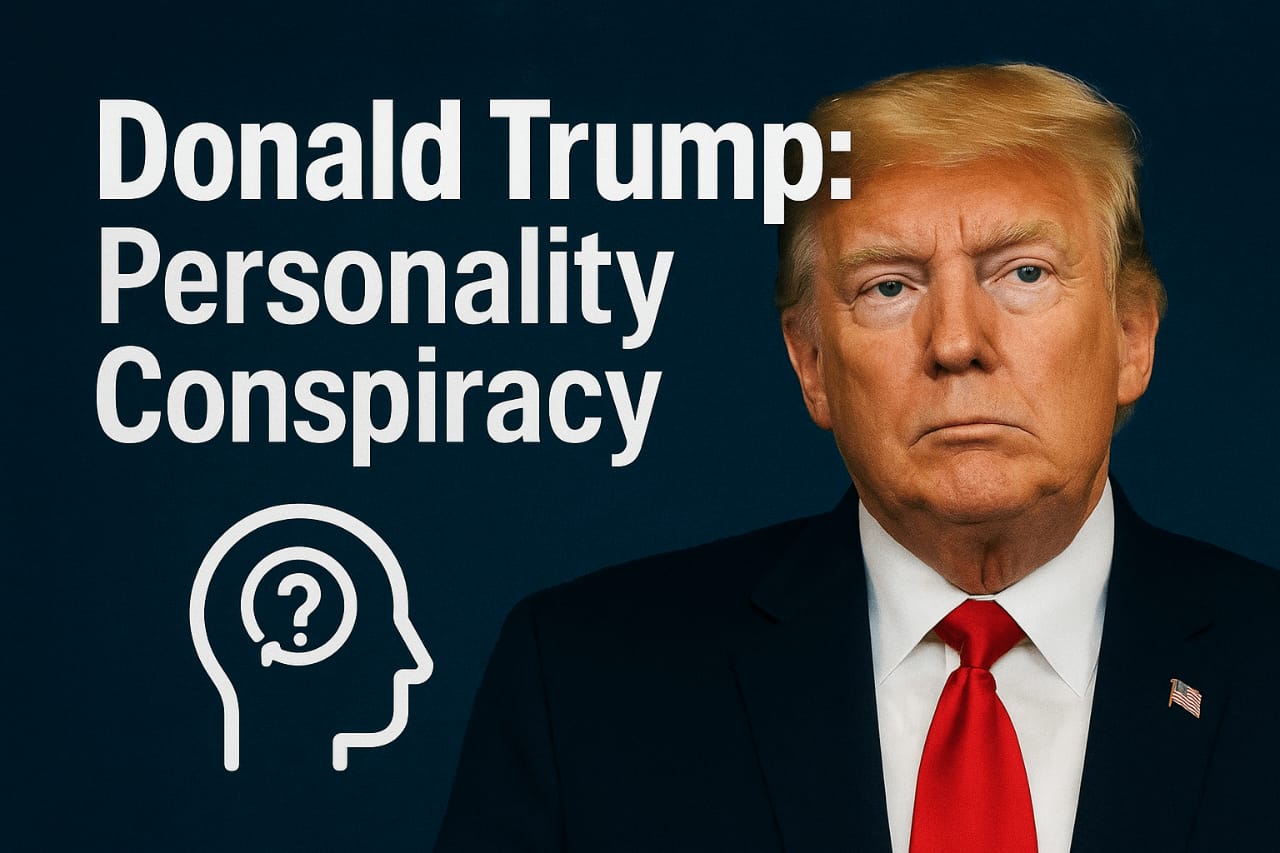
Donald Trump: Personality Conspiracy – A Critical Investigation
Reading Summary
This investigative report examines claims about Donald Trump’s personality that have circulated widely in media, social networks, and public discourse. It distinguishes between evidence-based personality analysis and speculative “personality conspiracies”, providing verified information with sources and a clear framework for evaluating each claim.
Scope
- Topic: Claims and conspiracies related to Donald Trump’s personality.
- Included: Observable behavior, public statements, court records, verified personality-related claims.
- Excluded: Medical or psychological diagnoses, unsupported speculation, rumors without credible sources.
- Evaluation Method: Each claim is categorized as Verified, Disputed, or Unfounded, based on primary documents, secondary sources, and expert commentary.
Introduction
The term “personality conspiracy” refers to claims suggesting that Donald Trump’s behavior and character are secretly manipulated, orchestrated, or inherently malicious, without concrete evidence. These claims range from exaggerations of wealth and power to supposed hidden agendas behind public statements.
This investigation separates verified facts from rumor, focusing on evidence that can be independently verified, such as public records, interviews, legal documents, and official statements.
Methodology
- Primary Sources: Speeches, official records, legal filings, tax documents, interviews.
- Secondary Sources: Credible news outlets, books, scholarly articles, investigative journalism.
- Opinion: Clearly labeled editorials or commentary.
- Claim Categorization:
- Verified: Supported by primary evidence.
- Disputed: Conflicting information; cannot fully confirm.
- Unfounded: No credible evidence; rumor or speculation.
Claims Analysis
| Claim | Status | Evidence | Source |
|---|---|---|---|
| Trump exaggerates crowd sizes | Verified | Photos and independent reports show discrepancies between actual crowd sizes and his statements. | Newsweek, 2024 |
| Trump secretly controlled major media outlets | Unfounded | Investigations show no ownership or direct control; claims originated from anonymous sources. | FactCheck.org, 2020 |
| Trump avoided paying federal taxes | Verified | NYT analysis of IRS documents shows he paid minimal federal taxes in multiple years. | NYT, 2020 |
| Trump colluded with foreign governments | Unfounded | Mueller investigation found no conclusive evidence of criminal collusion. | Mueller Report, 2019 |
| Trump downplayed COVID-19 severity for political advantage | Verified | Public statements contradict CDC guidance; documents show awareness of risks. | Washington Post, 2020 |
Timeline of Key Events
| Date | Event | Source |
|---|---|---|
| Jan 20, 2017 | Trump inaugurated as President | WhiteHouse.gov |
| Oct 2018 | Public statements on trade tariffs | CNN |
| Nov 2020 | Disputed 2020 election claims | Reuters |
| Mar 2020 | Downplayed COVID-19 in early briefings | Washington Post, 2020 |
Case Study: “Collusion with Foreign Governments”
- 2016: Social media speculation about Russian interference.
- 2017–2019: Investigations by multiple news outlets and Congress; conflicting interpretations.
- 2020: Mueller Report concluded insufficient evidence of criminal collusion → Unfounded.
Update Log
| Date | Change | Source |
|---|---|---|
| Oct 8, 2025 | Added verified claims table | Multiple sources |
| Oct 9, 2025 | Updated timeline with COVID-19 references | Washington Post, CNN |
Key Takeaways
- Personality conspiracies are often unverified claims presented as hidden truths.
- Verified evidence relies on primary sources like legal documents, official records, and credible journalism.
- Disputed claims should be approached with caution; unfounded claims have no verified backing.
- Neutral language and clear sourcing ensure readers can distinguish fact from rumor.
FAQ
Q: What is a “personality conspiracy”?
A: Claims about Trump’s personality that rely on speculation or hidden-plot narratives rather than evidence.
Q: Are medical or psychological diagnoses included?
A: No. Only observable public behavior and verified actions are discussed.
Q: How are claims verified?
A: By cross-referencing primary sources, legal documents, official statements, and reputable reporting.
Q: How should readers use this article?
A: Review the claims table, check sources, and reference the timeline for context.
How to Fact-Check
- Verify statements using official government records and speeches.
- Check reputable news organizations (NYT, Washington Post, CNN).
- Avoid anonymous sources or social media speculation.
- Compare conflicting reports and rely on primary documentation.
About The Author




buy legal marijuana online from trusted dispensary sources