
Contents
- 1 Caste System in India: Historical Roots, Legal Reforms, and Modern Challenges
- 1.1 Key Takeaways
- 1.2 Introduction
- 1.3 Historical Evolution
- 1.4 Key Concepts Explained
- 1.5 Legal Framework & Constitutional Safeguards
- 1.6 Reservation Policies: Reality vs Promise
- 1.7 Caste in Modern India
- 1.8 Ongoing Challenges
- 1.9 Investigative Case Examples
- 1.10 Path Forward: Legal, Economic, and Social Reforms
- 1.11 FAQ (with Schema-Ready Format)
- 1.12 Sources
- 1.13 Glossary
Caste System in India: Historical Roots, Legal Reforms, and Modern Challenges
Updated on: October 2025
Key Takeaways
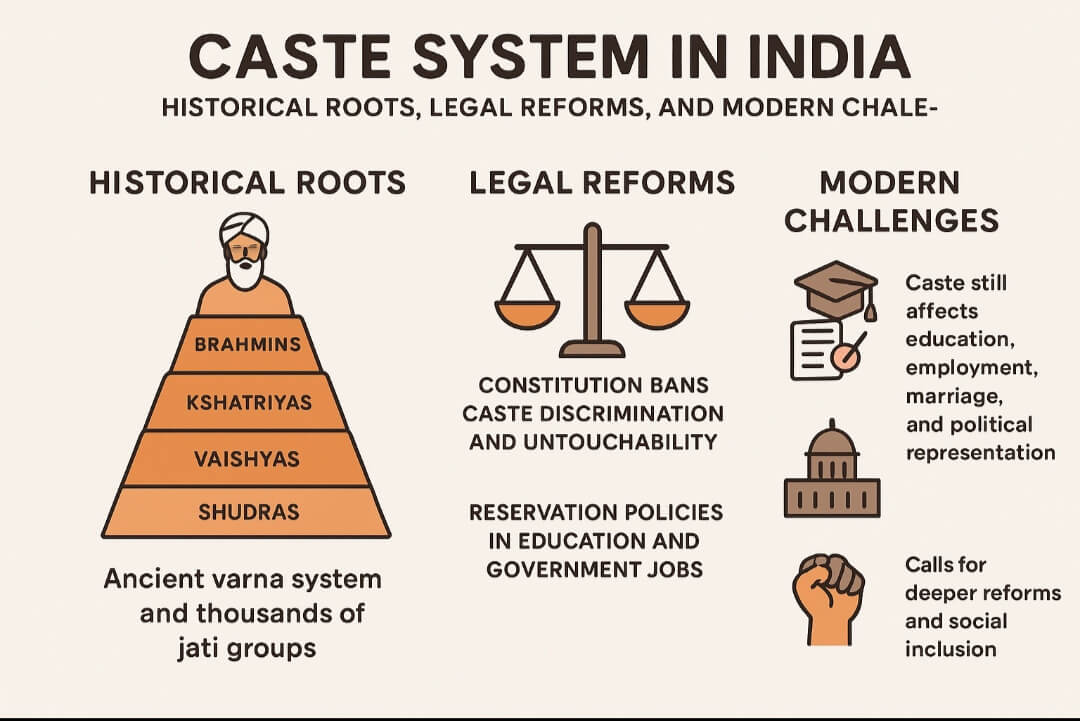
- The caste system in India is a stratified social hierarchy shaped by varna ideals and thousands of jati groups.
- India’s Constitution bans caste discrimination and untouchability, with safeguards for Scheduled Castes (SC) and Scheduled Tribes (ST).
- Reservation policies in education and government jobs support SC, ST, and Other Backward Classes (OBC) to address historic exclusion.
- Caste still affects access to education, employment, marriage, and political representation despite urbanization and legal reforms.
- Effective reform requires combining legal protection, education, economic mobility, and social inclusion.
Introduction
The caste system remains one of India’s most persistent social institutions. Rooted in ancient varna ideology and reinforced by thousands of local jati groups, it continues to shape social interactions, opportunities, and political dynamics. While India’s Constitution outlaws caste discrimination, and legal mechanisms aim to uplift marginalized communities, evidence shows that caste still influences education, employment, marriage, and access to power. This article investigates the historical evolution, legal reforms, and contemporary challenges of caste, highlighting the gaps between policy and reality.
Historical Evolution
Ancient Foundations
The concept of caste originated with the varna system, a theoretical fourfold division in Vedic texts: Brahmins (priests), Kshatriyas (warriors), Vaishyas (traders), and Shudras (laborers). Although intended as an idealized framework, local jatis (birth-based communities) evolved into thousands of hierarchical groups controlling occupation, marriage, and social status.
Medieval and Colonial Periods
During the medieval era, caste hierarchies became more rigid, with social mobility increasingly restricted. British colonial rule codified caste through census operations, legal recognition, and institutional policies. Colonial documentation, while ostensibly administrative, reinforced social stratification and laid the groundwork for caste-based politics in independent India.
Key Concepts Explained
- Varna: Theoretical fourfold classification from sacred texts.
- Jati: Real-world, localized birth groups defining occupation and social hierarchy.
- Untouchability: Social ostracism of marginalized groups, especially Dalits.
- SC/ST/OBC: Official categories recognized for affirmative action.
- Reservation: Government-mandated quotas in education, employment, and political representation.
- Social Mobility: Ability to move upward across social or economic strata.
“All India Leprosy Relief Association, Shirur Center.
Appeal for help to donors and service-minded individuals of the All India Leprosy Relief Association, Shirur Center.https://www.remitly.com/us/en
https://www.remitly.com/us/en/homepage
https://razorpay.me/@akhilbhartiyakusthasevasangh
Legal Framework & Constitutional Safeguards
The Indian Constitution provides a robust legal framework against caste discrimination:
- Article 14: Equality before the law.
- Article 15: Prohibits discrimination based on caste, religion, sex, or place of birth.
- Article 17: Abolishes untouchability.
- Directive Principles: Encourage socio-economic justice for disadvantaged communities.
- Scheduled Castes and Tribes (Prevention of Atrocities) Act, 1989: Criminalizes violence and discrimination against SC/ST.
Despite these laws, enforcement gaps and social resistance often limit their impact.
Reservation Policies: Reality vs Promise
Reservation aims to redress historic exclusion. Key facts:
| Category | Education Quota | Government Jobs Quota | Observed Challenges |
|---|---|---|---|
| SC | 15% | 15% | Unequal access, dropout rates remain high |
| ST | 7.5% | 7.5% | Remote regions lack facilities |
| OBC | 27% | 27% | Socio-economic disparities persist |
Investigative Insight: While quotas improve formal access, disparities in private education, social networks, and wealth often prevent meaningful inclusion.
Caste in Modern India
Education
SC literacy stands at 73.7%, compared to 84.6% for the general population (Census 2011). Enrollment gaps persist in rural areas and private schools, reflecting structural barriers.
Employment
Approximately 49% of SCs work in informal labor markets, compared to 33% of the general population (PLFS 2023). Professional advancement is frequently limited by social networks and implicit bias.
Social & Political Influence
Caste remains central to marriage patterns, with inter-caste marriages at only 11% nationally (IHDS 2012). Politically, caste identity influences candidate selection, party alliances, and voting behavior, demonstrating that legal frameworks alone cannot eliminate deep-seated social divisions.
Ongoing Challenges
- Caste-Based Violence: Crimes against Dalits continue, despite the 1989 SC/ST Act.
- Economic Inequality: Landlessness, low-paying informal jobs, and limited credit access reinforce marginalization.
- Social Stigma: Urbanization reduces visibility but subtle discrimination persists in workplaces and neighborhoods.
- Policy Gaps: Reservation implementation varies by state, often bypassing intended beneficiaries.
Investigative Case Examples
- Higher Education Access: Dalit students report discriminatory treatment in elite universities, limiting graduation and professional opportunities.
- Inter-Caste Marriage: Families resisting inter-caste unions continue to incite violence in some rural regions.
- Political Representation: Reserved seats ensure legislative access, but elite capture within SC/ST communities sometimes undermines broader empowerment.
Path Forward: Legal, Economic, and Social Reforms
- Legal Enforcement: Strengthen monitoring of anti-discrimination laws and implement fast-track courts for atrocities.
- Education & Awareness: Increase quality schooling in marginalized communities; provide mentorship and scholarships.
- Economic Inclusion: Promote access to credit, vocational training, and entrepreneurship for SC/ST/OBC groups.
- Social Integration: Encourage inter-caste dialogues, media campaigns, and affirmative employer practices to challenge stereotypes.
FAQ (with Schema-Ready Format)
Q1: What is the difference between varna and jati?
A1: Varna is a theoretical fourfold classification; jati are localized, birth-based social groups.
Q2: Is caste discrimination illegal in India?
A2: Yes. The Constitution bans untouchability and discrimination based on caste.
Q3: Who benefits from reservation policies?
A3: Scheduled Castes (SC), Scheduled Tribes (ST), and Other Backward Classes (OBC) in education and government jobs.
Q4: Does caste still influence daily life?
A4: Yes. It shapes social networks, marriage patterns, access to education, and employment opportunities.
Q5: Which laws protect against caste-based violence?
A5: Article 17 of the Constitution and the SC/ST (Prevention of Atrocities) Act, 1989.
Sources
- Constitution of India, 1950
- Census of India, 2011
- National Sample Survey Office (NSSO) Reports, 2023
- Indian Human Development Survey (IHDS), 2012
- Ministry of Social Justice & Empowerment, Government of India
- National Crime Records Bureau (NCRB) Data, 2022
- Reputable journals: Economic and Political Weekly, Journal of Social Inclusion Studies
Glossary
- Caste: Social stratification based on birth.
- Varna: Theoretical fourfold system from sacred texts.
- Jati: Localized, occupation-based community.
- SC: Scheduled Castes; historically marginalized.
- ST: Scheduled Tribes; indigenous communities.
- OBC: Other Backward Classes; socially and educationally disadvantaged.
- Untouchability: Practice of ostracism against lower castes.
- Reservation: Affirmative action policy in education, employment, and politics.
- Social Mobility: Ability to move across social and economic strata.
About The Author



1 thought on “Caste System in India: Historical Roots, Legal Reforms, and Modern Challenges”