
Contents
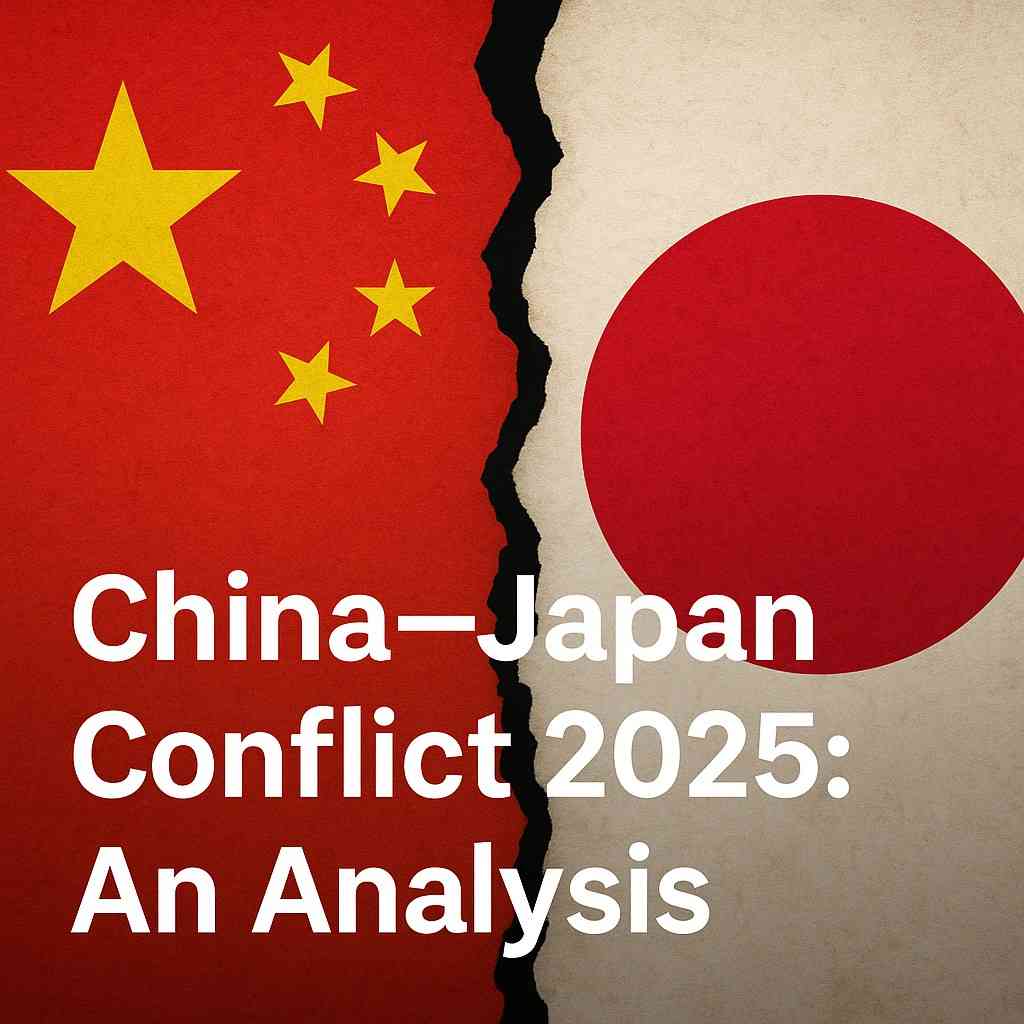
China–Japan Conflict 2025: An Analysis
Writer- Dr.Nitin Pawar,Pune.21 November 2025
This article examines the escalating conflict between China and Japan in 2025, exploring its historical roots, key flash-points such as Taiwan and the Senkaku/Diaoyu Islands, the strategic implications for the Indo-Pacific region and India, and possible future scenarios. External links provided for deeper reading.
Introduction
In 2025, relations between China and Japan have plunged to one of their lowest points in decades. Recent events have forced the two Asian powers into a serious diplomatic, economic and strategic standoff. For the readers of exposer.blog, this article offers a readable yet detailed account of what is happening, why it matters, and what might come next.
Historical context
To understand the current situation, we need to glance at the past.
- China and Japan share a long and troubled history — including Japan’s invasion of China in the 1930s and the legacy of the Second Sino‑Japanese War.
- Post-World War II, Japan adopted pacifist features in its constitution, while China rose as a regional power.
- Over recent years, major tension points include the East China Sea maritime disputes (particularly the Senkaku Islands / Diaoyu Islands), Japan’s evolving security posture, China’s naval expansion, and Taiwan’s unresolved status.
What’s new in 2025? Key flash-points
Taiwan & Japan’s role
Japan’s Prime Minister Sanae Takaichi stated in November that a hypothetical Chinese attack on Taiwan could trigger Japan’s collective defence rights. China responded with sharp protests, viewing Japan’s comments as interference in its “core interests”.
The result: a breakdown in diplomatic trust and heightened military + strategic anxiety.
Senkaku / Diaoyu Islands & military moves
China sent coast-guard vessels and drones into Japan-administered waters around the Senkaku Islands, which Beijing calls the Diaoyu Islands, declaring patrols to “enforce rights”.
Japan raised alarm at increased Chinese naval and air presence near its southern islands.
Economic & diplomatic retaliation
China announced it would suspend imports of Japanese seafood as part of the dispute.
The Chinese commerce ministry said trade cooperation with Japan has been “severely damaged”.
Public diplomacy and travel/state-visits
China urged its citizens to avoid travel/study in Japan, suspended Japanese films and cultural exchanges.
Japan warned its citizens in China about safety.
Why this matters
- Regional security: The Japan-China standoff occurs in the broader context of the Indo-Pacific and involves major players like the Taiwan Strait, the U.S. alliance system, and maritime chokepoints.
- Trade & economy: China and Japan are significant trading partners; disruptions affect supply-chains across Asia. The seafood import ban is a warning sign.
- India’s interest: As an Indo-Pacific power, India watches this conflict closely. Shifts in Japanese security policy or China’s posture may affect India-China ties and regional balance.
- Global norms & alliances: Japan’s increasing readiness to consider collective defence and China’s assertiveness at sea raise questions about international law, the United Nations framework, and whether old norms are robust.
Possible scenarios for the future
- Diplomatic de-escalation: Both sides step back, issue face-saving statements, resume cultural/trade ties, perhaps via third-party mediation.
- Prolonged cold standoff: Relations remain frozen, trade/emphasis on security increase, military deterrence rises but no outright conflict.
- Limited military clash: A miscalculation around the Senkaku/Diaoyu or Taiwan leads to naval or aerial incident, raising the risk of broader confrontation.
- Escalated war-scenario: In the event of a Taiwan crisis, Japan enters militarily and China retaliates — dragging in US allies and destabilizing the entire region. (Worst-case but must be considered.)
Implications for India & the world
- Japan could strengthen its defence cooperation with India, Australia, and the U.S., pushing a more assertive “Quad +” posture.
- China might respond by increasing pressure along its borders (including with India) to offset attention.
- Supply chains might shift further: companies may reconsider where they source from Japan/China due to risk.
- A precedent: how Japan behaves in the Taiwan/China context could influence other small states with China disputes (e.g., in South China Sea).
What to watch in coming months
- Whether Japan revises or clarifies its security legislation around collective self-defence.
- Whether China continues large scale military manoeuvres near Japanese islands or Taiwan.
- Economic indicators: whether trade flows drop significantly, or if other sanctions emerge.
- Diplomatic moves: meetings between Japanese and Chinese leaders, new multilateral forums involving both.
- Incremental incidents at sea/air: near-misses, coast guard patrols, which tend to raise risk of escalation.
FAQs
Q1. Are Japan and China at war?
No. As of 2025 they are not at open war, but tensions are high and relations have deteriorated significantly.
Q2. What triggered the current crisis?
A major trigger was Prime Minister Takaichi’s comment that a Chinese attack on Taiwan could constitute an existential threat to Japan, prompting sharp Chinese protest.
Q3. What are the Senkaku/Diaoyu Islands?
They are a group of uninhabited islets in the East China Sea administered by Japan but claimed by China (and Taiwan). Recent patrols by Chinese coast guard vessels in these waters have escalated tension.
Q4. How might this affect India?
India faces a changing regional security architecture: increased Japan-US cooperation may benefit India, but a stronger China in the region may also pose challenges. Japan’s defence upgrades may open new strategic partnerships for India.
Q5. What is the likelihood of full-blown war between China and Japan?
While possible in extreme scenarios (such as a Taiwan crisis), most analysts view the probability as low in the near term. The more likely path is a protracted cold standoff with periodic incidents.
For more references :
- “China and Japan are in a war of words over Taiwan – what happens next?” (The Guardian) → Link
- “China says trade cooperation with Japan ‘severely damaged’” (Reuters) → Link
- “China to suspend imports of Japanese seafood amid diplomatic row” (Al Jazeera) → Link
Conclusion
The China-Japan conflict of 2025 is more than a bilateral spat — it is a signal of shifting strategic patterns in the Indo-Pacific. For observers in India and elsewhere the stakes are high: trade, security, alliances, and regional order all hang in the balance. Vigilance, diplomacy, and strategic clarity will define how this crisis evolves — and whether it remains manageable or spins into something far worse.
Read more >>>>>>
How does the global arms industry influence wars in the world?
Unraveling the Educational ‘Curriculum’: Who Determines Our History, Our Thoughts?
Donald Trump: Personality Conspiracy – A Critical Investigation
About The Author




2 thoughts on “China–Japan Conflict 2025: An Analysis”