
Contents
- 1 EVM Conspiracy in India – Facts vs Fiction (2025 Updated Analysis)
- 1.1 Key Takeaways
- 1.2 The Origins of the EVM Conspiracy
- 1.3 How Indian EVMs Actually Work
- 1.4 What VVPAT Adds to the Process
- 1.5 Security and Chain of Custody: The 7-Layer Protocol
- 1.6 Claim vs Fact vs Source
- 1.7 The Political Narrative: Trust, Technology, and Suspicion
- 1.8 Legal and Technical Oversight
- 1.9 How to Verify as a Voter
- 1.10 FAQ
- 1.11 Conclusion: Between Evidence and Emotion
- 1.12 Sources & References
EVM Conspiracy in India – Facts vs Fiction (2025 Updated Analysis)
Introduction
Every election season in India brings back one persistent question: Can Electronic Voting Machines (EVMs be hacked?
Social media narratives, viral videos, and political press conferences have turned EVMs into a recurring symbol of distrust. Yet, behind the noise lies a system that has evolved over two decades, tested repeatedly by courts, technical experts, and civil society observers.
This exposé investigates the technology, the safeguards, and the politics surrounding the so-called “EVM conspiracy” — separating evidence-based facts from orchestrated misinformation.
Key Takeaways
- Indian EVMs are standalone, non-networked devices — they cannot connect to the internet or any wireless system.
- The VVPAT system provides a visible paper trail for each vote, stored securely for verification.
- Randomization, sealing, and CCTV-monitored custody protect machines from tampering.
- Courts and the Election Commission of India (ECI) have found no proof of systemic EVM hacking in any election.
- Voters can report anomalies to the presiding officer, triggering a formal verification process.
(Verified from ECI Handbook 2023, Supreme Court Order April 2019, TEC Report 2021)
The Origins of the EVM Conspiracy
EVMs were introduced in India in 1982 in limited constituencies and became nationwide by 2004.
Despite widespread acceptance, controversies began surfacing after 2010 when political losses often triggered allegations of “machine manipulation.”
The term “EVM conspiracy” entered public discourse not as a proven fact but as a political narrative tool — a way to frame electoral defeat as a question of integrity rather than popularity.
In the 2019 general elections, several opposition parties petitioned the Supreme Court, alleging EVM vulnerability. The Court (April 8, 2019) ruled there was no credible evidence of manipulation and expanded VVPAT verification from one booth per constituency to five to ensure confidence.
How Indian EVMs Actually Work
An Indian EVM consists of two main units:
- Ballot Unit (BU): Where voters press a button for their candidate.
- Control Unit (CU): Where votes are recorded and stored securely.
Both run on one-time programmable firmware, meaning the code cannot be rewritten or updated remotely.
EVMs have no Wi-Fi, Bluetooth, or GSM modules. They operate offline on internal batteries and can only communicate when connected physically to each other under official supervision.
(Source: ECI Technical Manual 2022, BEL & ECIL design documents)
What VVPAT Adds to the Process
The Voter Verifiable Paper Audit Trail (VVPAT) was introduced nationally in 2019.
It shows the voter a seven-second slip confirming their choice, which is then sealed in a transparent box.
After polling, random samples of these slips are manually counted and compared to the digital vote count from EVMs.
In every test and court audit to date, no mismatch beyond random human error has been found.
(Source: TEC Report on EVM & VVPAT, 2021; ECI Summary Note, 2023)
Security and Chain of Custody: The 7-Layer Protocol
The ECI’s EVM security protocol is among the most elaborate in the world:
- Randomization: Machines are allocated to constituencies and booths by computer software to prevent prediction or manipulation.
- Mock Poll: Before voting begins, each booth conducts a 50-vote mock poll in the presence of party agents.
- Sealing and Signatures: Machines are sealed, signed by all party representatives, and documented.
- Polling Day Supervision: Polling officials and agents verify serial numbers before the first vote.
- Strongroom Storage: After voting, EVMs and VVPATs are stored in double-locked rooms under CCTV surveillance and police guard.
- Counting Day Verification: Seals are opened before candidates’ agents, and VVPAT samples are matched.
- Post-Count Audit Trail: Machines are preserved for six months, available for court verification if disputes arise.
(Sources: ECI Handbook for Returning Officers, 2023; Election Laws Manual, 2024)
Claim vs Fact vs Source
| Claim | Fact | Source |
|---|---|---|
| EVMs can be hacked via Bluetooth or Wi-Fi. | Indian EVMs are not networked and contain no wireless hardware. | TEC Report (2021), BEL Design Manual |
| EVMs can be pre-programmed to favor a party. | Machines are randomized twice — before and after candidate list finalization. | ECI Protocol Document (2023) |
| EVMs record votes incorrectly. | Every EVM is tested through mock polls before use. Errors, if any, are replaced immediately. | ECI Mock Poll Guidelines (2022) |
| Courts ignored manipulation complaints. | Supreme Court reviewed multiple petitions and found no evidence of tampering. | Supreme Court Orders (2017–2019) |
| VVPAT slips are not properly verified. | Five booths per constituency undergo manual VVPAT cross-checks. | ECI Press Release (2019) |
The Political Narrative: Trust, Technology, and Suspicion
EVMs have become a symbol of political psychology as much as technology.
When parties win, they hail the system; when they lose, EVMs become the scapegoat.
Between 2014 and 2024, more than 70 instances of “EVM malfunction” reports were investigated — none involved hacking, only battery or display errors.
Misinformation, however, travels faster than technical reports.
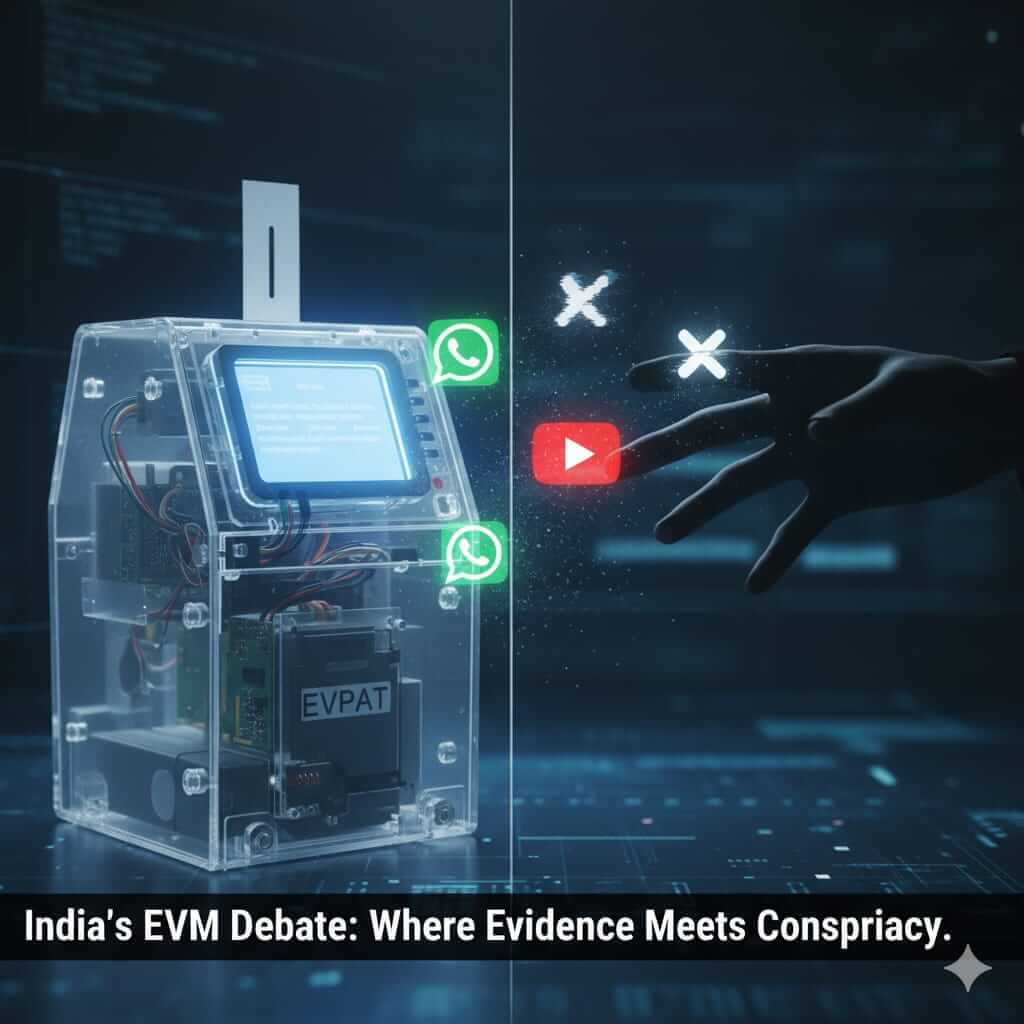
Doctored videos, sensational headlines, and coordinated WhatsApp forwards amplify distrust.
Experts note that this serves political mobilization, keeping supporters emotionally engaged in a narrative of victimhood.
(Source: Centre for Media Studies Election Report, 2024; Alt News Fact Checks 2023)
Legal and Technical Oversight
The Supreme Court of India, in a series of rulings (notably N. Chandrababu Naidu vs Union of India, 2019), upheld the reliability of EVMs and directed increased VVPAT sampling “to reinforce public confidence.”
The Technical Expert Committee (TEC), composed of scientists from IIT Delhi, IISc Bengaluru, and DRDO, audits EVM design periodically.
Their 2021 report reaffirmed that “no evidence exists of any remote or pre-programmed tampering.”
Independent observers from national and international agencies have also found India’s voting process secure but transparency-sensitive, recommending greater public awareness rather than systemic overhaul.
How to Verify as a Voter
Voters play an essential role in verification. Here’s what you can do:
- Observe the mock poll conducted before voting begins.
- Check your VVPAT slip to ensure your choice is printed correctly.
- Report any discrepancy immediately to the presiding officer.
- Record serial numbers or details if you intend to file a complaint later.
- Follow up with the Returning Officer; complaints can trigger EVM replacement or re-poll orders.
(Source: Conduct of Election Rules, 1961; ECI Voter Awareness Manual, 2024)
FAQ
Q: How do Indian EVMs work?
A: EVMs consist of a ballot and control unit connected via cable, running on secure firmware. They are sealed and log each vote physically. (ECI Handbook, 2023)
Q: What is VVPAT and why does it matter?
A: VVPAT prints a paper slip showing the voter’s choice for a few seconds, ensuring transparency. (TEC Report, 2021)
Q: Can EVMs be hacked remotely?
A: No. They are completely offline and not capable of remote connectivity. (BEL Technical Note, 2022)
Q: What safeguards exist on polling day?
A: Randomization, mock polls, sealing, strongroom storage, and CCTV custody. (ECI Manual, 2023)
Q: What should I do if I suspect a mismatch?
A: Report it immediately to the presiding officer and lodge a written complaint. (Election Rules, 1961)
Conclusion: Between Evidence and Emotion
The EVM controversy reveals as much about India’s political culture as its electoral machinery.
Facts, when buried under emotion and propaganda, lose their ability to persuade.
India’s EVM system is not perfect — no system is — but every credible audit so far shows it is functionally secure, legally validated, and publicly verifiable.
Transparency can always improve, but distrust cannot replace data.
As long as citizens remain informed, vigilant, and evidence-driven, democracy remains stronger than conspiracy.
Sources & References
- Election Commission of India – EVM and VVPAT Handbook, 2023
- Supreme Court of India – Writ Petition (Civil) No. 273/2019, April 8, 2019
- Technical Expert Committee – Report on EVM Design and Security, 2021
- BEL & ECIL – Hardware Specification Notes, 2022
- Alt News & Centre for Media Studies – Election Mis/Disinformation Report, 2024
- Conduct of Election Rules, 1961 – Ministry of Law & Justice, India
Author Bio
Dr. Nitin Pawar
Investigative Journalist | Founder – Exposer.blog
With over two decades of experience in public policy, civic transparency, and election monitoring, Dr. Pawar writes on the intersection of technology, democracy, and accountability.
Last Updated: October 2025
About The Author